

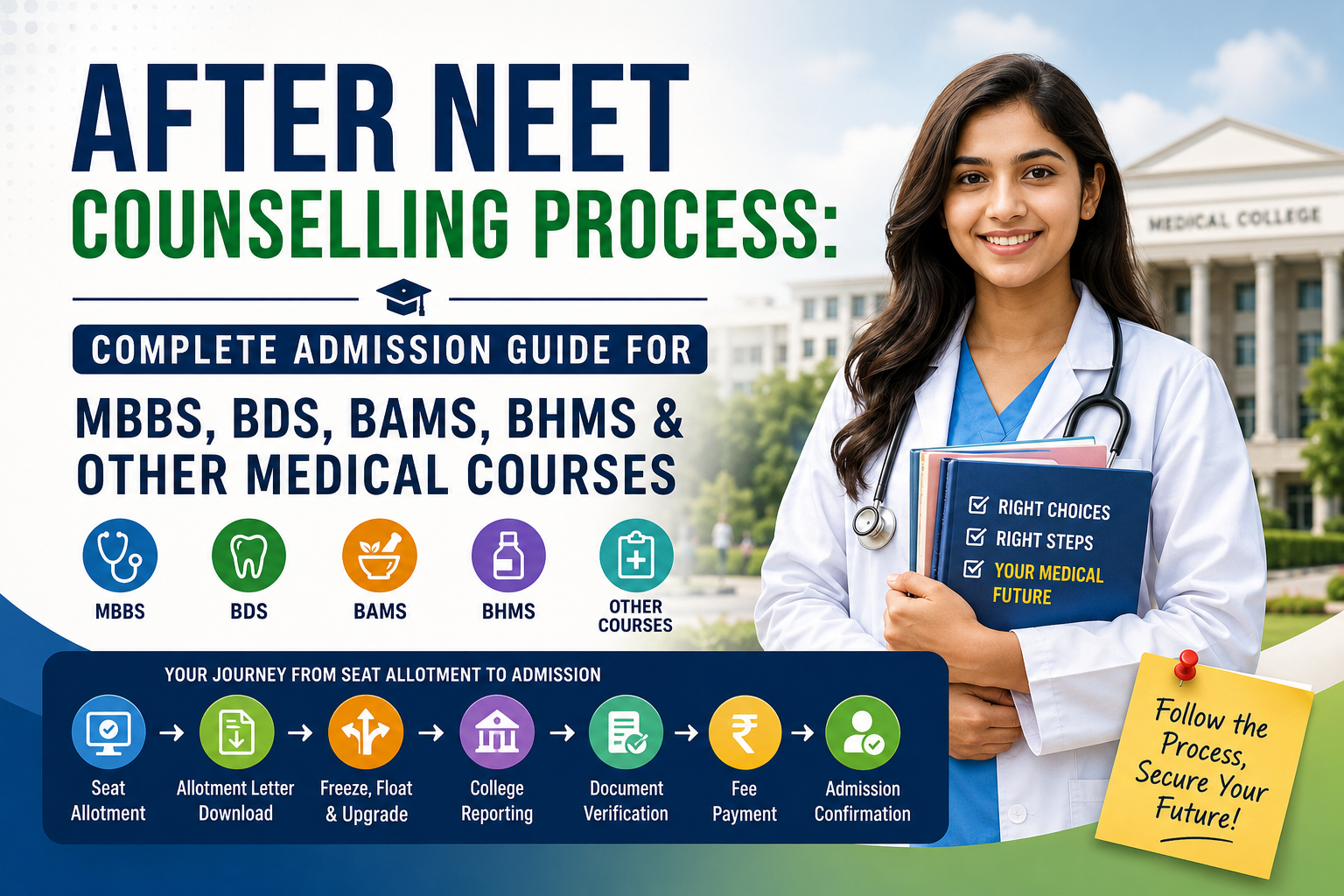
After NEET Counselling Process: Complete Admission Guide for MBBS, BDS, BAMS, BHMS & Other Medical Courses
Every year, lakhs of students clear NEET and feel a huge sense of relief — only to find themselves completely lost the moment the After NEET counselling process actually begins. Clearing the exam was step one. What comes next — choice filling, seat allotment, freezing or floating a seat, document verification, fee payment — is an entirely different challenge, and most students get no formal guidance on it.
This confusion is completely normal. Schools and coaching institutes spend years preparing students for the NEET exam itself, but almost no time preparing them for what happens after the result is declared. Questions like "Should I freeze my seat or try to upgrade?", "What documents do I actually need to carry?", "What happens if I miss the reporting deadline?", and "Is the process different for BAMS or BHMS compared to MBBS?" are asked by nearly every NEET-qualified candidate and their parents.
This guide is built to remove that confusion completely. We will walk through the entire NEET UG counselling journey in the exact sequence it happens in real life — from seat allotment to final admission confirmation — and cover the process separately for MBBS, BDS, BAMS, BHMS, and other AYUSH and allied courses. By the end, you will know exactly what to do at every stage of the medical admission process, what documents to keep ready, which mistakes to avoid, and how rounds like Mop-Up and Stray Vacancy actually work.
What is the NEET Counselling Process?
The NEET counselling process is the official admission mechanism through which NEET UG-qualified candidates are allotted seats in medical, dental, AYUSH, and other healthcare courses across India, based on their rank, category, and choices filled during registration. It is conducted in two parallel streams:
- MCC Counselling (All India Quota – 15%): Conducted by the Medical Counselling Committee (MCC) under the Directorate General of Health Services for 15% All India Quota seats in government medical and dental colleges, all AIIMS, JIPMER, central universities (BHU, AMU, DU), ESIC, AFMC, and deemed/private universities for MBBS and BDS.
- State Quota Counselling (85%): Conducted independently by each state's counselling authority for the remaining 85% of seats in government and private colleges within that state, along with 100% seats in private colleges (except deemed universities).
Importantly, MBBS and BDS counselling is handled by MCC for AIQ seats and by state authorities for state quota seats, while AYUSH courses (BAMS, BHMS, BUMS, BSMS) follow a similar dual structure — 15% AIQ seats through AACCC (AYUSH Admissions Central Counselling Committee) and 85% state quota seats through respective state AYUSH/CET cells.
A student must clear the NEET UG cutoff, register separately for each counselling body they wish to participate in (MCC and their home state, at minimum), fill choices, and go through seat allotment rounds until they secure and confirm a seat.
What Happens After NEET Counselling process?
This is the part most students struggle with. Once results are out and registration opens, the NEET counselling process moves through eight clearly defined stages. Understanding each one in sequence prevents almost every common mistake students make.
After choice filling and locking closes for a round, the counselling authority (MCC, state body, or AACCC) runs its allotment algorithm, matching your NEET rank, category, domicile/quota eligibility, and order of choices against available seats. You are allotted the highest-preference choice you're eligible for. If you don't get any choice, you remain unallotted and can try the next round.
If allotted a seat, a provisional allotment letter is generated on the portal (mcc.nic.in, AACCC portal, or state portal) with your name, roll number, allotted college, course, category, and round details. Download and print it — it's needed at every later stage.
In many state systems (and some MCC sub-processes), you must explicitly accept the allotted seat online before reporting. Missing this digital declaration deadline can result in automatic seat cancellation in several states.
The most important decision point: Freeze means you're satisfied and exit the process. Float means you keep the current seat while staying open to an upgrade in the next round. Upgrade lets you move to a higher-preference choice from Round 2 onward, often without losing the already-allotted seat.
You must physically report to the allotted college within the deadline with all original documents. Failure to report results in forfeiture of the seat. First round is free exit, but from Round 2 onward, not reporting can disqualify you from further rounds.
The admission committee verifies your original documents against declared/uploaded information. Mismatched names, missing category certificates, or expired domicile proofs can delay or block admission.
Once documents are verified, you pay the admission/tuition fee (and security deposit, where applicable). Government college fees are nominal; private and deemed university fees are significantly higher.
After fee payment, the college issues an admission/joining letter and you're officially enrolled, with your name forwarded to the regulatory body (NMC, NCISM, or NCH depending on the course).

Documents Required After NEET Counselling
Carrying the correct documents — in original plus photocopies — is non-negotiable. Missing even one can mean losing your seat on reporting day. Based on AIQ, state, and AYUSH counselling requirements, here is the complete list.
| Document | Purpose | Copies Needed |
|---|---|---|
| NEET UG Admit Card | Identity and exam roll number proof | Original + 2 photocopies |
| NEET UG Result/Rank Letter | Proof of qualifying rank and percentile | Original + 2 photocopies |
| Provisional Seat Allotment Letter | Proof of seat allotment for the round | Original + 2 photocopies |
| Class 10th Marksheet & Certificate | Date of birth proof | Original + 2 photocopies |
| Class 12th Marksheet & Certificate | Educational eligibility proof | Original + 2 photocopies |
| Photo ID (Aadhaar/PAN/Passport/Voter ID) | Identity verification | Original + 2 photocopies |
| Passport-size Photographs | Same as used in registration | 8–10 copies |
| Category Certificate (SC/ST/OBC-NCL/EWS) | Required for reserved category benefit | Original + 2 photocopies |
| PwD/PwBD Certificate | Required only for disability quota | Original + 2 photocopies |
| Domicile/Residence Certificate | Mandatory for state quota eligibility | Original + 2 photocopies |
| Migration Certificate | If from a different board/state | Original + 2 photocopies |
| Transfer Certificate (TC) | From last school/institution | Original + 2 photocopies |
| Medical Fitness Certificate | Confirms fitness for the course | Original |
| Conduct/Character Certificate | From last attended school/college | Original + 1 photocopy |
| Anti-Ragging Undertaking | Affidavit by candidate and parent | Printed & signed copy |
| Aadhaar Card | Identity and address proof | Original + 2 photocopies |
| Nationality Certificate | Required in some states | Original + 2 photocopies |
| Gap Year Affidavit (if applicable) | If gap between Class 12 and admission | Original notarized copy |
MBBS Admission Process After NEET Counselling
MBBS remains the most sought-after course, and the MBBS admission process after NEET follows this structured path.For MBBS aspirants, the NEET Counselling Process is the only gateway to secure admission in government and private medical colleges.:
- Qualify NEET UG with marks at or above the qualifying percentile for your category.
- Register separately on the MCC portal (mcc.nic.in) for AIQ seats, and on your home state's portal for state quota seats.
- Fill and lock choices in genuine order of preference during each round's window.
- Check seat allotment by logging into the respective portal as per schedule.
- Decide freeze, float, or upgrade based on your satisfaction with the allotted seat.
- Report to the allotted college within the deadline with all original documents.
- Complete document verification through the college's admission committee.
- Pay admission and tuition fees as per the declared fee structure.
- Receive admission confirmation and complete biometric/Aadhaar verification where applicable.
- Participate in further rounds (Round 2, Mop-Up, Stray Vacancy) only if not frozen, or if seats remain vacant.
- Final admission and registration — your details are forwarded to the National Medical Commission (NMC).
Students aiming for MBBS through state quota must also check whether their state requires a domicile certificate, 10+2 from a recognized board within the state, or a minimum residency period — these eligibility rules vary significantly by state.
BDS Admission Process After NEET Counselling
The BDS admission process mirrors the MBBS process closely, since both are counselled together by MCC for AIQ seats, but with a few course-specific points:
- Qualify NEET UG with the applicable cutoff (same exam, same cutoff structure as MBBS).
- Register on the MCC portal for 15% AIQ BDS seats, and the state portal for 85% state quota BDS seats.
- Many states conduct combined MBBS+BDS counselling, where you fill choices for both together.
- Fill and lock choices — dental colleges are listed separately from medical colleges.
- Check seat allotment results; BDS often has more rounds of vacancy filling than MBBS.
- Decide freeze/float/upgrade based on whether you'd prefer BDS or wait for a possible MBBS upgrade.
- Report to the allotted dental college with the same document set as MBBS.
- Complete document verification and fee payment — check the fee structure before reporting.
- Receive admission confirmation; enrollment is governed under the relevant dental regulatory framework.
- Participate in Mop-Up and Stray Vacancy rounds if needed.
Dental admissions are also completed through the NEET Counselling Process, making NEET mandatory for BDS admission.
BAMS Admission Process After NEET Counselling
The BAMS admission process (Bachelor of Ayurvedic Medicine and Surgery) is conducted through a separate but parallel structure under the AYUSH counselling system:
- Qualify NEET UG with the prescribed cutoff for AYUSH courses.
- Register on the AACCC portal (aaccc.gov.in) for 15% AIQ BAMS seats.
- Simultaneously register on your state AYUSH/CET counselling portal for 85% state quota BAMS seats.
- Fill and lock choices separately on each portal; for deemed universities, you typically express willingness as an option.
- Pay the requisite registration/security deposit fee (refundable after counselling if no rules are violated).
- Check seat allotment results across Round 1, Round 2, Round 3, and Stray Vacancy Round (SVR).
- Decide freeze/float/upgrade — leaving an allotted seat in later rounds usually carries financial penalties.
- Report to the allotted Ayurvedic college with original documents, including medical fitness and category certificates.
- Complete document verification and fee payment at the college.
- Receive admission confirmation; enrollment is recorded under the NCISM framework.
Students interested in Ayurveda must participate in the NEET Counselling Process conducted through AACCC and state AYUSH authorities.
BHMS Admission Process After NEET Counselling
The BHMS admission process (Bachelor of Homoeopathic Medicine and Surgery) follows the same AACCC/state dual structure as BAMS, regulated separately by the National Commission for Homoeopathy (NCH):
- Qualify NEET UG with the applicable cutoff for AYUSH courses.
- Register on the AACCC portal for 15% AIQ BHMS seats and your state's AYUSH portal for 85% state quota seats.
- Fill and lock choices across government, government-aided, and (where applicable) deemed university colleges.
- Pay the counselling registration fee/security deposit as specified.
- Track seat allotment results for Round 1, Round 2, Round 3, and the Stray Vacancy Round.
- Make your freeze/float/upgrade decision, considering that BHMS often has a wider rank range than BAMS.
- Report physically to the allotted homoeopathic college with all documents.
- Undergo document verification and complete fee payment.
- Receive admission confirmation and complete enrollment, subsequently reported to NCH.
The NEET Counselling Process for BHMS follows a similar structure with registration, choice filling, seat allotment, and reporting.
Admission Process for Other NEET Courses
NEET UG is the gateway not just to MBBS, BDS, BAMS, and BHMS, but to several other AYUSH and allied health courses. The overall structure remains similar, with a few course-specific details:
BUMS (Bachelor of Unani Medicine and Surgery)
Counselled through AACCC (15% AIQ) and respective state AYUSH cells (85% state quota), following the same round structure as BAMS and BHMS. Regulated under NCISM.
BSMS (Bachelor of Siddha Medicine and Surgery)
Primarily relevant for candidates in Tamil Nadu and a few other states where Siddha colleges exist, counselled through AACCC for AIQ seats and state-specific AYUSH counselling for the remainder.
BNYS (Bachelor of Naturopathy and Yogic Sciences)
BNYS counselling is generally conducted at the state level, so candidates must check their respective state AYUSH or health department portal for registration, seat matrix, and round schedules.
Veterinary Courses (B.V.Sc & AH)
Admission uses NEET UG scores but is counselled separately by the Veterinary Council of India (VCI) for 15% AIQ seats, while remaining seats are filled through state veterinary counselling bodies.
Nursing Courses (B.Sc Nursing, where NEET-linked)
Certain B.Sc Nursing seats — particularly at AIIMS and a few central institutions — are filled based on NEET UG scores through MCC counselling, alongside separate entrance/merit processes in many states.
Difference Between MBBS, BDS, BAMS, BHMS Admission Process
| Parameter | MBBS | BDS | BAMS | BHMS |
|---|---|---|---|---|
| AIQ Authority | MCC | MCC | AACCC | AACCC |
| State Quota Authority | State Medical Cell | State Medical/Dental Cell | State AYUSH/CET Cell | State AYUSH/CET Cell |
| Regulatory Body | NMC | Dental body under NCISM | NCISM | NCH |
| Duration | 5.5 yrs (incl. internship) | 5 yrs (incl. internship) | 5.5 yrs (incl. internship) | 5.5 yrs (incl. internship) |
| Typical Rounds | R1, R2, Mop-Up, SVR | R1, R2, Mop-Up, SVR | R1, R2, R3, SVR | R1, R2, R3, SVR |
| Demand Level | Highest | High | Moderate | Moderate |
| Govt. Fee Range | Low | Low | Low–Moderate | Low–Moderate |
| Private Fee Range | Very High | High | Moderate–High | Moderate–High |
Understanding Round 1, Round 2, Mop-Up Round & Stray Vacancy Round
Almost every counselling authority — MCC, AACCC, and state bodies — follows a similar multi-round structure, with each round typically lasting 10 to 15 days.
Round 1
The first and largest round, open to all NEET-qualified candidates who registered and locked choices. Allotment is based purely on rank, category, and choice order.
Round 2
Open to candidates who missed Round 1 registration, as well as those who floated or remained unallotted. New registration is generally allowed here too.
Mop-Up Round
Conducted to fill seats remaining vacant after Round 2, primarily for AIQ seats. New registration is allowed, but only against genuinely vacant seats.
Stray Vacancy Round
The final round to fill any seats still vacant after Mop-Up. Allotment is done automatically without fresh choice filling, and reporting timelines are often extremely short (24–48 hours), so staying alert to notifications is essential.
Common Mistakes Students Make After NEET Counselling
- Not registering with both MCC and state counselling simultaneously — missing out on either AIQ or state quota options.
- Filling too few choices — listing only 3–5 colleges drastically reduces allotment chances.
- Filling choices carelessly without checking fee structure, location, or hostel facilities.
- Forgetting to manually lock choices, relying solely on auto-lock at deadline.
- Misunderstanding freeze vs float — accidentally freezing an unwanted seat or floating without understanding consequences.
- Missing the reporting deadline, even by a few hours, resulting in seat forfeiture.
- Carrying incomplete or incorrect documents — expired certificates or mismatched photos.
- Not keeping enough photocopies, assuming the college will provide photocopying facilities.
- Ignoring state-specific eligibility rules like domicile period requirements.
- Not tracking official notifications closely, missing Stray Vacancy round alerts with short windows.
- Assuming AYUSH counselling works exactly like MBBS and missing AACCC-specific steps.
- Panic-accepting a low-preference seat without checking statistical chances in later rounds.

Important Tips for Students and Parents
- Register on every applicable portal (MCC + home state + AACCC, if relevant) right when registration opens.
- Research colleges thoroughly before choice filling — check recognition status, fees, hostel facilities, and past closing ranks.
- Fill a long, well-ordered choice list, even for colleges you're unsure about.
- Understand your state's specific freeze/float/upgrade rules before the allotment result is out.
- Prepare a complete document folder in advance with extra photocopies and photographs.
- Keep a checklist of deadlines for every round and set reminders.
- Don't rely solely on coaching institute "expected cutoff" predictions — refer to official previous-year data.
- If unsure about freeze vs float, consult your counsellor or verified seniors.
- Always verify the authenticity of any third-party counselling website — trust only official portals.
- Stay calm and alert during the Stray Vacancy Round — seats can disappear within hours.
Frequently Asked Questions
What is the NEET counselling process?
The NEET counselling process is the official, multi-round system through which NEET UG-qualified candidates are allotted seats in MBBS, BDS, AYUSH, and allied courses, based on rank, category, and choices filled, conducted by MCC for 15% All India Quota seats and respective state authorities for 85% state quota seats.
What happens immediately after NEET UG results are declared?
After results, the relevant counselling authorities (MCC, state bodies, AACCC) release the counselling schedule, open registration, and candidates begin the choice-filling process for the first round.
Is registration for MCC and state counselling done separately?
Yes. MCC registration (for AIQ seats) and state counselling registration (for state quota seats) are completely separate processes on different portals, and most candidates should register for both to maximize their options.
What is the difference between freeze, float, and upgrade in NEET counselling?
Freeze means accepting the current seat and exiting the process; float means accepting the current seat for now while remaining open to a better allotment in later rounds; upgrade means moving to a higher-preference choice while remaining within the counselling system.
What documents are required for NEET counselling reporting?
Key documents include the NEET admit card, result/rank letter, provisional allotment letter, Class 10 and 12 certificates, photo ID proof, passport photographs, category certificate (if applicable), domicile certificate, migration certificate, transfer certificate, and a medical fitness certificate.
What happens if I miss the college reporting deadline?
Missing the reporting deadline typically results in forfeiture of the allotted seat, and depending on the round and authority's rules, you may also be disqualified from participating in further rounds of that counselling cycle.
Can I change my preferred college after seat allotment?
Yes, through the float or upgrade option in subsequent rounds, subject to the specific rules of the counselling authority you registered under — but this is not guaranteed and depends on seat availability and your rank.
How many rounds does NEET counselling have?
Most NEET counselling processes are conducted in four rounds: Round 1, Round 2, Mop-Up Round (or Round 3 for AYUSH), and the Stray Vacancy Round, though the exact number can vary by year and authority.
What is the Stray Vacancy Round in NEET counselling?
The Stray Vacancy Round is the final round conducted to fill seats still vacant after the Mop-Up Round, where allotment is generally made directly without a fresh choice-filling step, and reporting deadlines are typically very short.
Is choice filling compulsory for every round?
Choice filling is required for Round 1, Round 2, and the Mop-Up Round in most systems, but it is typically not required for the Stray Vacancy Round, where allotment is made automatically against remaining vacancies.
What is the MBBS admission process after NEET counselling?
After qualifying NEET, candidates register on MCC and their state portal, fill and lock choices, receive seat allotment, choose freeze/float/upgrade, report to the allotted college with documents, complete verification and fee payment, and receive final admission confirmation.
Is the BDS admission process different from MBBS?
The overall structure is largely the same since MCC counsels both together for AIQ seats, but BDS colleges are listed separately, and many states conduct combined MBBS+BDS counselling where allotment depends on relative rank and seat availability.
How is the BAMS admission process different from MBBS?
BAMS uses a separate counselling authority — AACCC for AIQ seats and state AYUSH cells for state quota seats — rather than MCC, and is regulated by NCISM rather than NMC, though the broader steps are conceptually similar.
What is AACCC and what does it do?
AACCC (AYUSH Admissions Central Counselling Committee) is the central body under the Ministry of AYUSH that conducts All India Quota counselling for undergraduate AYUSH courses including BAMS, BHMS, BUMS, BSMS, and B.Pharm (Ayurveda).
Do I need to pay a fee during NEET AYUSH counselling registration?
Yes, AACCC and most state AYUSH counselling bodies require a registration fee or security deposit at the time of registration, which is generally refunded after counselling concludes provided no allotment rules are violated.
What is state quota counselling in NEET?
State quota counselling refers to the process conducted independently by each state's designated authority for 85% of medical/dental/AYUSH seats reserved for candidates meeting that state's domicile or eligibility criteria.
Can outstation students apply for state quota seats?
Generally, state quota seats are reserved for candidates who meet that state's domicile criteria, though some states have specific provisions or relaxed rules for certain categories — check the target state's eligibility notification carefully.
What happens if I don't report after floating my seat?
This depends on the specific counselling authority's rules — in some systems, not reporting after floating can still preserve your earlier allotted seat if not upgraded, while in others, failing to report can lead to seat cancellation, so always check specific instructions for your round.
How is the seat allotment result calculated?
Seat allotment is calculated through an automated process that matches your NEET rank, category, quota eligibility, and order of choices filled against seats available in that round, allotting the highest-ranked available choice you're eligible for.
What if I am not satisfied with my allotted seat?
You can choose to float (if available) and try for an upgrade in the next round, or in some systems withdraw entirely from a particular round, though withdrawal rules and penalties vary across authorities and should be checked carefully.
Is medical fitness certificate mandatory for all courses?
Yes, a medical fitness certificate from a registered medical practitioner is generally a mandatory document across MBBS, BDS, BAMS, BHMS, and other NEET-counselled courses at the time of college reporting.
Conclusion
The NEET counselling process does not end the moment your result is declared — in many ways, that is exactly where it truly begins. From registering on the right portals and filling well-researched choices, to understanding freeze, float, and upgrade options, reporting on time with a complete set of documents, and finally confirming your admission through fee payment, every stage matters. Whether you are pursuing MBBS, BDS, BAMS, BHMS, or any other AYUSH or allied health course, the underlying framework remains similar, even though the conducting authorities — MCC, AACCC, or your state counselling cell — differ. By understanding this guide thoroughly, keeping your documents ready in advance, and avoiding the common mistakes outlined above, you and your family can navigate the entire NEET counselling process with far more confidence and far less last-minute panic, ultimately securing the medical seat that matches your hard-earned NEET rank.