

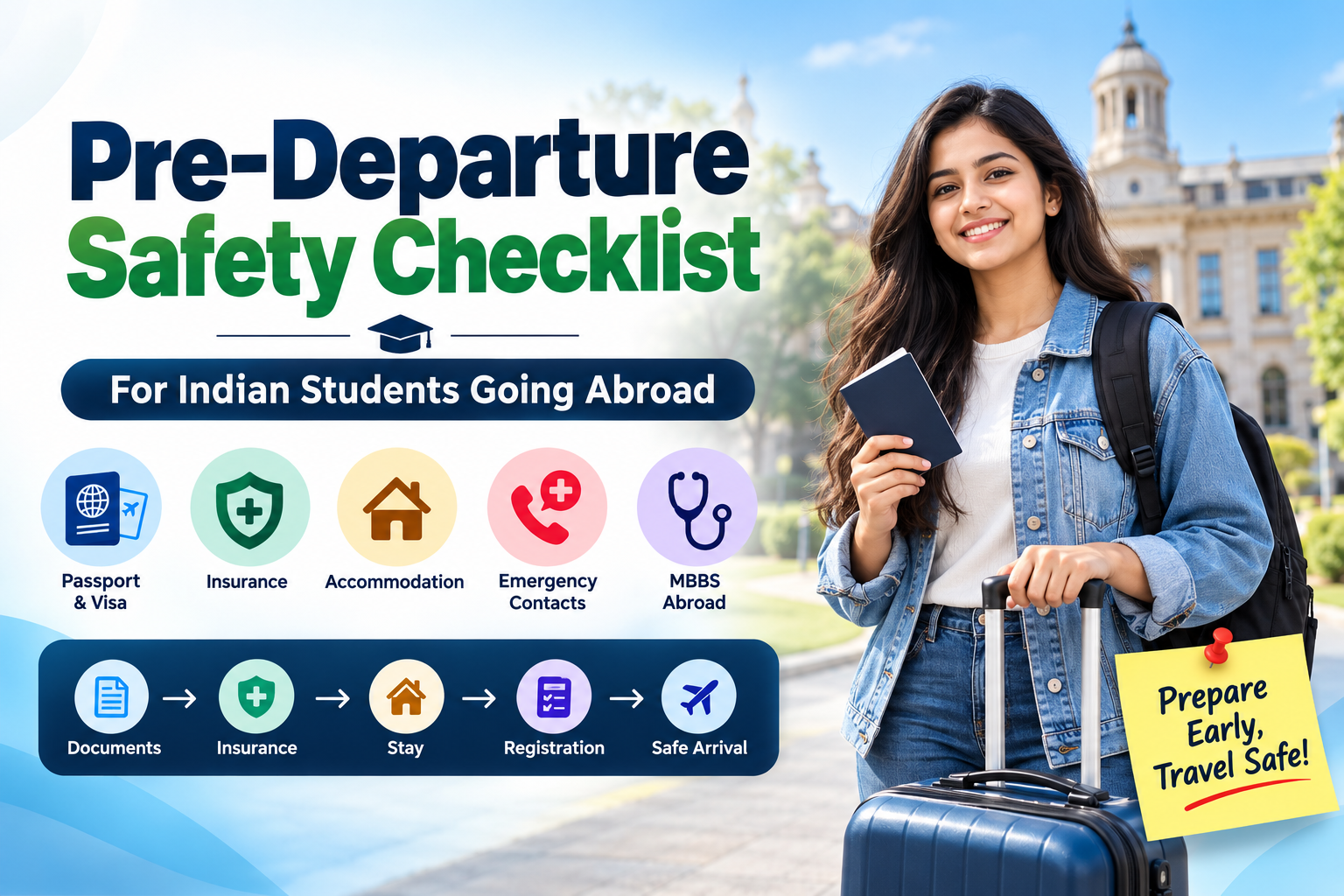
Pre-Departure Safety Checklist for Indian Students Going Abroad
The pre-departure safety checklist for Indian students going abroad is an essential guide for students and parents preparing for international education. Before boarding a flight, students must verify their travel documents, understand local laws, confirm accommodation and prepare for medical or personal emergencies. Proper planning helps prevent avoidable problems during the journey and the initial days in a new country.
Moving abroad for higher education is a major transition. For students pursuing MBBS in Russia, Georgia, Kazakhstan, Kyrgyzstan or another destination, preparation involves more than securing admission and obtaining a student visa. Students also need to understand local customs, transport options, healthcare facilities and university safety procedures.
The Ministry of External Affairs (MEA) advises Indian students to obtain the appropriate study visa, verify their university's recognition and familiarise themselves with the destination country's laws and living conditions. Use this checklist before departure and review country-specific requirements with the relevant authorities.
15 Essential Pre-Departure Safety Checks for Indian Students
Check Your Passport and Student Visa
Your passport and visa are among the most important travel documents. Before leaving India:
- Check your passport's expiry date and the validity required by your destination.
- Confirm that your visa is appropriate for your intended course and duration of stay.
- Verify your name, passport number and other personal details on your travel documents.
- Check whether your destination requires additional entry documents or immigration procedures.
- Keep digital and printed copies of your passport and visa separately from the originals.
The MEA recommends checking passport validity well in advance and carrying copies of essential documents. Its general travel guidance mentions six months of passport validity beyond the planned return date; however, verify the specific requirements for your destination and itinerary.
Verify Your University and Admission Documents
Confirm that your admission is genuine and that your institution is appropriately recognised by the relevant authorities. Keep these documents ready:
- Official admission or enrolment letter
- Tuition fee payment receipts
- University contact details
- Accommodation confirmation
- Academic certificates and mark sheets
- NEET scorecard and other course-specific documents where applicable
- Copies of any required translations, attestations or legalisations
For Indian students pursuing MBBS abroad, checking a university's recognition and the applicable National Medical Commission (NMC) requirements is particularly important. Do not rely solely on an agent's claims or promotional material.
Arrange Suitable Travel and Medical Insurance
Unexpected medical treatment, travel disruption or lost baggage can create financial difficulties overseas. Before purchasing insurance, check:
- Whether emergency hospitalisation and medical treatment are covered.
- Whether emergency evacuation or repatriation is included.
- Whether the policy covers the entire planned stay.
- Whether pre-existing conditions, prescribed medicines or specific activities are excluded.
- How to contact the insurer and submit a claim.
Also check whether your university or destination country requires a particular type of insurance. Do not assume that a standard travel policy automatically meets every student visa or university requirement.
Confirm Safe Accommodation Before Travelling
Students should know exactly where they will stay after landing. Confirm these details with your university or accommodation provider:
- Full residential address
- Booking confirmation and payment terms
- Hostel or housing rules
- Security arrangements and access procedures
- Availability of heating, internet and basic facilities where relevant
- Distance from the university and nearest medical facility
If you are using private accommodation, verify the landlord and rental agreement before making substantial payments. Avoid sending money to unverified individuals based only on social media messages. Share your confirmed address with your parents or trusted family members.
Save Emergency Contacts Before Departure
Do not wait until an emergency occurs to search for important phone numbers. Save these contacts in your phone and keep a written backup:
| Contact | Information to Keep |
|---|---|
| Indian Embassy or Consulate | Official contact details for your destination |
| Local emergency services | Police, ambulance and fire services |
| University | International student office and student support team |
| Accommodation | Hostel warden, landlord or residence manager |
| Insurance provider | Emergency assistance and claims contact |
| Family | At least two trusted contacts in India |
Use the official website of the relevant Indian Mission to obtain current contact details. Emergency numbers vary by country.
Register with the Indian Embassy Through MADAD
The MEA provides a student registration facility through its MADAD consular services portal. Registration allows the government to maintain information about Indian students abroad and can help facilitate communication during emergencies. Students should:
- Visit the official MADAD portal.
- Select the registration option for Indian students abroad.
- Complete the requested personal and course details.
- Keep the registration information accessible.
- Update relevant details if they change.
Check the portal's current instructions before submitting information. Registration does not replace local emergency services or guarantee a particular form of assistance.
Understand Local Laws and Cultural Practices
Laws and social expectations can differ considerably between countries. Research:
- Local identification requirements
- Public transport and road safety regulations
- Rules concerning alcohol, smoking and prohibited substances
- Restrictions on photography in sensitive locations
- Public behaviour and cultural expectations
- Laws governing employment while holding a student visa
For MBBS students, understanding local language basics and appropriate behaviour in clinical or hospital settings can also make daily life easier. Always follow local laws, even when the rules differ from those in India.
Prepare Your Medicines and Health Records
If you take regular medication, consult a qualified healthcare professional before travelling. Check whether the medicine is permitted in your destination country and whether a prescription or additional documentation is required. Pack, where applicable:
- Prescriptions and relevant medical records
- Vaccination records if required
- A medical fitness certificate if requested by the university
- Details of allergies or ongoing treatment
- Essential medicines in their original packaging
Do not assume that a medicine legally available in India can be carried into every country. Verify import restrictions with the destination country's official authorities.
Plan Your Money and Payment Methods
Financial preparation helps students manage expenses without relying entirely on cash. Before departure:
- Estimate initial accommodation, food and transport expenses.
- Check international transaction fees with your bank.
- Confirm that your debit or credit card works overseas.
- Understand the permitted methods for carrying foreign currency.
- Keep emergency funds separate from routine spending.
- Save proof of tuition payments and other significant transactions.
Never share banking passwords, card PINs or one-time passwords with strangers claiming to represent a university, bank or immigration authority.
Check Your Flight and Arrival Arrangements
Confirm your flight details, baggage allowance and airport transfer. Keep your admission letter, passport, visa and other travel documents in your hand baggage, never in checked luggage. Also verify:
- Airport terminal and reporting time
- Transit visa requirements, if applicable
- Arrival airport and expected arrival time
- Whether university pickup has been formally confirmed
- How you will reach your accommodation if pickup is delayed
If a person claiming to be your university representative meets you at the airport, verify their identity before entering a vehicle.
Secure Your Phone and Digital Accounts
Your phone will often be your main source of navigation, communication and emergency information. Prepare it by:
- Enabling a strong screen lock.
- Activating two-factor authentication on important accounts.
- Backing up essential contacts and documents securely.
- Downloading offline maps and translation tools.
- Checking international roaming or local SIM options.
- Enabling device tracking where available.
Avoid connecting to unfamiliar Wi-Fi networks for sensitive financial transactions. Never send passport scans or personal documents to unverified contacts.
Learn How to Travel Safely in Your Destination
Research local transport options before travelling from the airport or moving around your university city. Prefer official public transport, university-approved transfers or reputable transport providers, and check vehicle and driver details before entering a hired vehicle. Students should also:
- Share their route with a trusted person when appropriate.
- Avoid isolated locations when unfamiliar with the area.
- Learn the safest routes between accommodation and campus.
- Follow local traffic rules.
- Keep valuables secure in crowded places.
Safety practices should reflect the actual risks and conditions of the destination rather than assumptions about an entire country.
Understand Your University's Student Support System
Find out who can help if you experience harassment, illness, accommodation disputes or difficulties with immigration documentation. Before leaving India, identify the university's:
- International student office
- Student welfare or counselling department
- Campus security team
- Medical centre or affiliated hospital
- Accommodation support team
- Official complaint and grievance procedures
Save the relevant contacts and understand how to access assistance outside regular working hours.
Establish a Communication Plan with Your Parents
Agree on a simple communication routine before departure, which is particularly useful for students travelling internationally for the first time. Share your flight itinerary, arrival details, accommodation address and university contact information with your family.
Once you arrive, confirm that you have reached your accommodation safely, and inform your family if you change your phone number, residence or travel plans. Parents should also know which official university and embassy channels to use if they cannot reach the student.
Prepare a First-Week Essentials Kit
Your first few days may involve immigration formalities, university registration and settling into accommodation. Keep these ready:
- Original documents and their separate copies
- Phone, charger and suitable power adapter
- Basic toiletries and weather-appropriate clothing
- Prescription medicines and necessary medical records
- Payment cards and permitted emergency cash
- Accommodation address and transport instructions
- Emergency contact list
Check airline baggage restrictions and destination-country customs rules before packing. Do not carry restricted items simply because they are legally available in India.
Pre-Departure Checklist for MBBS Students Going Abroad
Students travelling for medical education should pay additional attention to their university documentation and academic requirements.
| Area | What to Verify |
|---|---|
| University | Institution identity and applicable recognition requirements |
| Admission | Official admission letter and enrolment instructions |
| Immigration | Correct visa and permitted duration of stay |
| Academics | Required certificates, mark sheets and NEET documentation |
| Accommodation | Confirmed hostel or residence arrangements |
| Health | Insurance, medical records and permitted medicines |
| Finances | Fee receipts and a realistic living-expense budget |
| Communication | University contacts and Indian Mission details |
Confirm requirements directly with your university and the relevant regulatory authorities, as they can differ by country, institution and course. For guidance on university selection and admission-related documentation, explore Medical Tree's MBBS abroad counselling information.
What Should Parents Verify Before Their Child Travels Abroad?
Parents can help reduce avoidable risks by reviewing the arrangements with their child before departure. Check that the student has a valid visa, confirmed accommodation, adequate funds and access to insurance information. Verify the university's official contact details and discuss how the student will travel from the airport to their residence.
Parents should also understand the destination's emergency procedures and retain copies of the travel itinerary. Encourage students to seek assistance through official university channels and the relevant Indian Mission whenever necessary. The objective is to help students become independent while ensuring they know where to turn when problems arise.
What to Do If an Emergency Occurs Abroad
If a student faces a serious incident, immediate safety should come first.
- Contact the local emergency services if there is an immediate threat to life or safety.
- Move to a safer location if possible.
- Inform the university's designated support team.
- Contact the relevant Indian Embassy or Consulate for appropriate consular assistance.
- Inform family members when it is safe to do so.
- Keep records of relevant documents, reports and communications.
The Indian Mission may be able to provide consular guidance within its authority. However, it cannot guarantee a particular outcome or replace local emergency, legal or medical services. For official guidance, consult the MEA's information for Indian students abroad.
Frequently Asked Questions
What should Indian students check before travelling abroad for studies?
Students should verify their passport, student visa, admission documents, accommodation, insurance, finances and arrival arrangements. They should also save emergency contacts and review the destination country's laws and entry requirements.
Should Indian students register with the Indian Embassy before going abroad?
Indian students should review the MEA's guidance and register through the official MADAD student registration facility where applicable. Registration can help the government maintain student details for communication and emergency coordination.
What documents should students carry when going abroad?
Students should carry their passport, valid visa, admission letter, academic documents, insurance details and accommodation confirmation. Additional documents may be required depending on the destination, university and course.
Is travel insurance necessary for Indian students studying abroad?
Insurance requirements vary by destination and institution. Students should verify mandatory coverage requirements and assess protection for medical emergencies, hospitalisation and other relevant risks before purchasing a policy.
How can parents ensure their child is prepared for MBBS abroad?
Parents should verify the university and admission documents, confirm accommodation and arrival arrangements, review insurance and emergency contacts and discuss communication plans. They should also encourage the student to understand local laws and university support procedures.
Planning to Pursue MBBS Abroad?
Medical Tree provides guidance on overseas medical education, university selection and admission-related documentation. Contact our counselling team to discuss your options and prepare for the next stage of your medical education journey.
Call +91 93159 87805Conclusion
Preparing for international education involves much more than booking a flight. A thorough pre-departure safety checklist for Indian students going abroad helps students and parents organise essential documents, plan accommodation, understand local rules and prepare for unexpected situations. Before travelling, verify important information with official authorities, keep emergency contacts accessible and confirm your university's instructions. For MBBS aspirants, careful planning should begin during the university selection and admission process rather than just before departure.
Admission outcomes depend on eligibility, applicable regulations and institutional requirements.